Complete Guide to NGO Registration in Pakistan
Complete Guide to NGO Registration in Pakistan
Under Trust Act 2020, Section 42 Companies Act 2017, Societies Registration Act 1860 & Voluntary Social Welfare Agencies Ordinance 1961
Adalat.Pk – Your Trusted Legal Resource for NGO & NPO Registration in Pakistan
Registering a Non-Governmental Organization (NGO) or Non-Profit Organization (NPO) in Pakistan is a crucial step for individuals and groups working in education, healthcare, poverty alleviation, women’s empowerment, environmental protection and other social welfare sectors. Proper legal registration enhances credibility, enables access to funding (local and foreign), opens dedicated bank accounts, provides tax benefits and ensures regulatory compliance.
1. Registration as a Trust under Provincial Trust Acts 2020
The Trusts Act 1882 has been replaced by provincial legislation:
· Punjab Trusts Act 2020
· Sindh Trusts Act 2020
· Khyber Pakhtunkhwa Trust Act/Rules 2020
· Balochistan Trusts Act 2020
· Islamabad Capital Territory Trust Act 2020
These laws emphasize transparency, accountability and compliance with Anti-Money Laundering (AML) and Counter-Terrorism Financing (CFT) standards.
Key Features:
· Suitable for smaller, asset-focused or family-run charitable initiatives.
· Trustee-centric governance with a Settlor transferring property/assets for public benefit.
· Perpetual succession possible.
Step-by-Step Registration Process:
1. Prepare a detailed Trust Deed on stamp paper outlining the name, objectives, settlor & trustees’ details, assets, management rules, and dissolution clause.
2. Gather documents: CNIC copies of settlor & trustees, photographs, affidavits, proof of assets (if any).
3. Submit the application to the relevant authority (e.g., Assistant Commissioner, Director Industries & Commerce or designated Registrar in your province).
4. Pay the prescribed fee (varies by province, often a few thousand rupees).
5. Receive the Certificate of Registration upon approval.
Pros: Relatively simpler and faster for local initiatives; lower initial costs. Cons: Provincial jurisdiction; increased reporting requirements post-2020; less suitable for large-scale national operations.
2. Registration under Section 42 of the Companies Act 2017 (Not-for-Profit Company)
Regulated by the Securities and Exchange Commission of Pakistan (SECP). This is the most professional and credible structure for NGOs seeking large grants and foreign funding.
Key Features:
· Company limited by guarantee (no share capital or dividends).
· Strong corporate governance with Board of Directors.
· License initially valid for 5 years (renewable).
Eligibility: Minimum 3 promoters/members.
Step-by-Step Process:
1. Apply for name availability through SECP eServices.
2. Submit application for License under Section 42 along with draft Memorandum & Articles of Association, financial projections, undertakings, and detailed documents.
3. Upon license approval, proceed with incorporation as a company.
4. Receive Certificate of Incorporation.
Documents Required (Main):
· CNICs/passports of promoters
· Draft MoA & AoA (as per SECP templates)
· Detailed work plan and financial estimates
· Undertakings, affidavits and resumes
· Proof of office address
Pros: High credibility, limited liability, nationwide recognition, easier access to international donors. Cons: Higher cost and time (several weeks to months); stringent ongoing compliance with SECP and audits.
3. Registration under the Societies Registration Act 1860
This colonial-era law (Act XXI of 1860) remains one of the most popular and simplest options for charitable, literary, scientific and educational societies.
Key Features:
· Membership-based democratic structure (General Body + Executive Committee).
· Minimum 7 members.
Process:
1. Prepare Memorandum of Association (objectives, address, managing committee) and Rules & Regulations.
2. Hold the first meeting and record minutes.
3. Submit documents to the Registrar of Societies / Joint Stock Companies (usually at district or provincial level).
4. Pay nominal fee (e.g., Rs. 2500 via treasury challan).
5. Obtain Certificate of Registration.
Pros: Easy, low-cost, flexible. Cons: May require additional approvals for foreign funding or large-scale projects.
4. Registration under the Voluntary Social Welfare Agencies (Registration and Control) Ordinance 1961
This Ordinance specifically targets voluntary agencies engaged in social welfare activities such as health, education, family planning, child welfare and rehabilitation.
Key Features:
· Strong focus on service delivery with government oversight.
· Registration with the Social Welfare Department.
Process:
1. Prepare the Constitution (model often available from the department).
2. Submit application in prescribed Form B with constitution, member lists and other documents.
3. Pay fee and undergo inspection/approval.
4. Receive registration certificate.
Pros: Ideal for direct welfare work; potential for government partnerships. Cons: More regulatory control and periodic reporting to the Social Welfare Department.
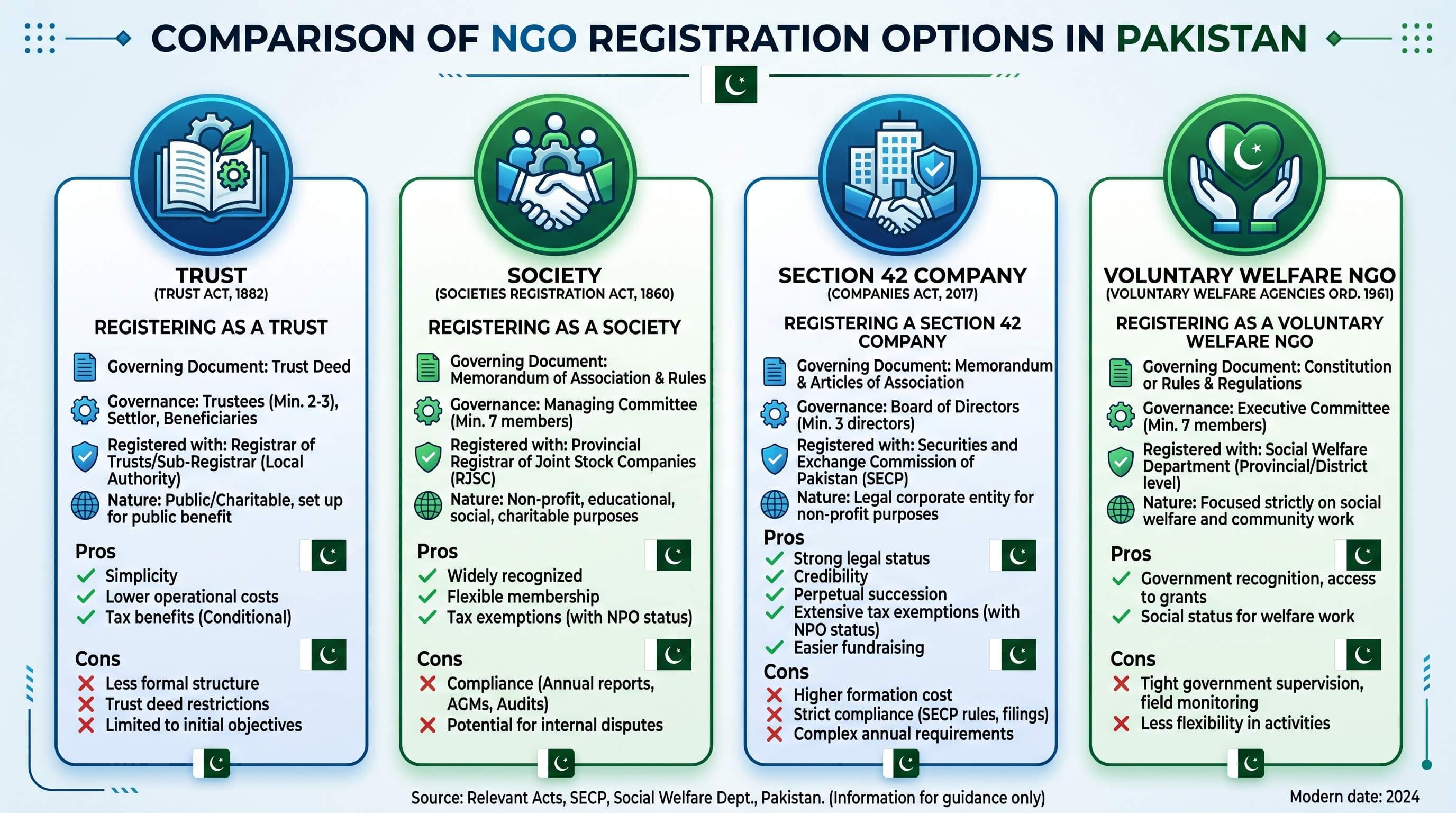
Comparison of NGO Registration Options in Pakistan
· Trust (2020 Acts): Asset-focused, fewer members, provincial registrar.
· Section 42 Company: Corporate structure, SECP, highest credibility for large NGOs.
· Society (1860): Membership-based, easiest and cheapest.
· Voluntary Welfare (1961): Service-oriented, Social Welfare Dept.
Choose according to your scale: Small/local → Trust or Society; National/International funding → Section 42 Company.
Post-Registration Requirements (Common to All)
· Open a dedicated current bank account in the organization’s name.
· Obtain National Tax Number (NTN) from FBR and apply for tax exemption (NPO status).
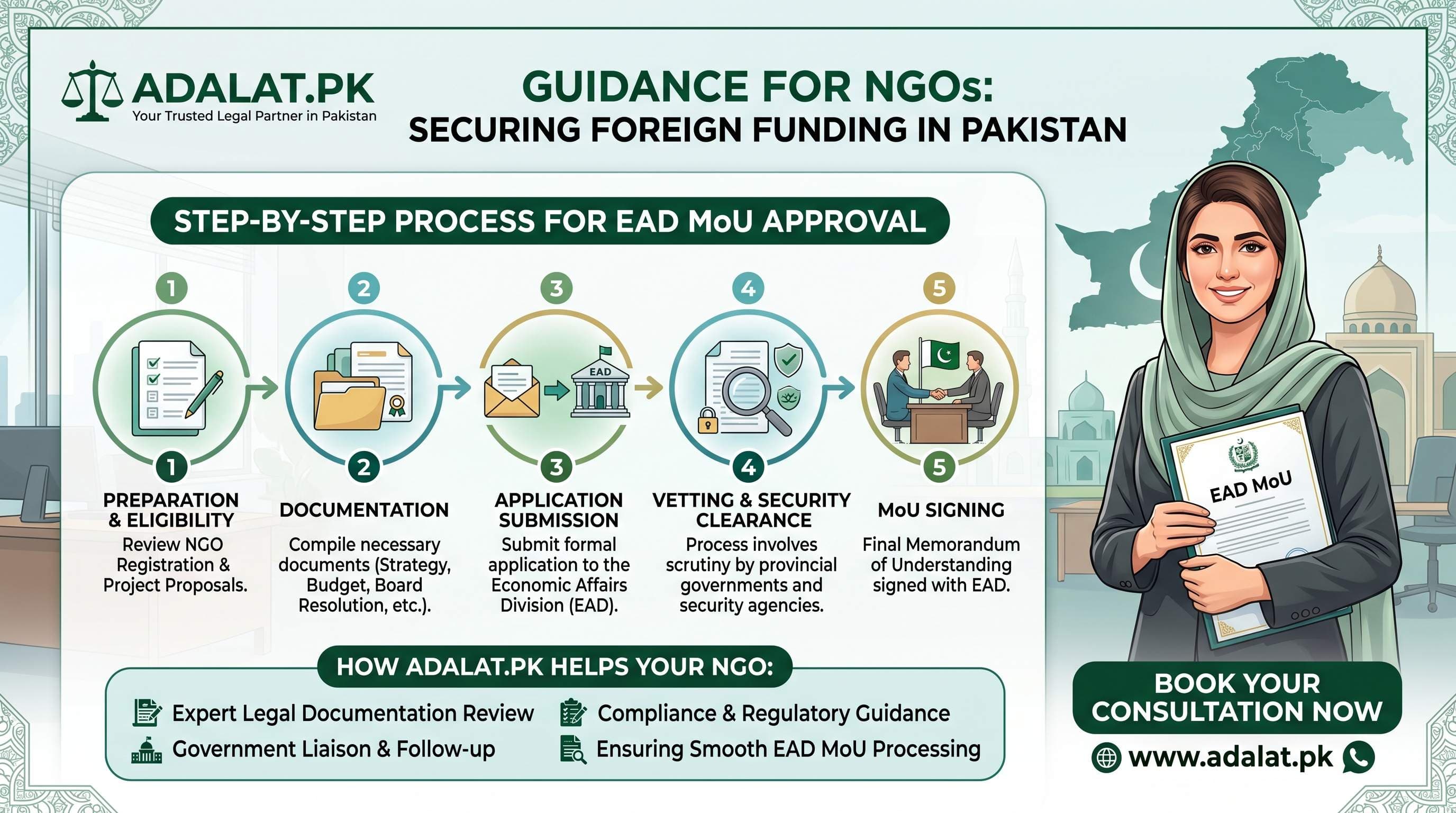
· Register with Economic Affairs Division (EAD) for foreign funding approval (where applicable).
· Maintain proper books of accounts, conduct annual audits, and file returns.
· Comply with AML/CFT regulations and provincial charity commissions (e.g., Punjab Charity Commission).
Tax Benefits: Approved NPOs enjoy exemptions on income from donations and grants under the Income Tax Ordinance 2001.
Important Tips for Successful NGO Registration
· Always consult a qualified lawyer for document drafting to avoid rejections.
· Verify latest fees and requirements with the concerned department, as they may vary by province.
· Ensure the name is unique and not similar to existing entities.
· Maintain transparency to build donor trust.
· Foreign-funded NGOs face additional scrutiny.
Registering an NGO is the foundation of sustainable social impact in Pakistan. Select the structure that best aligns with your vision, and ensure full compliance for long-term success.
Watch Video
Tags
Videos
Related videos
NGO Registration Under Societies Act, 1860 #NGO #Societies act#Charity#Commission
NGO Registration in Pakistan #NGO #NPO
Difference Between NGO & NPO #NGO #NPO
Need legal advice?
Speak to our legal experts for practical guidance on your case.
Get a Free Consultation1 Comment
Omparkash
27 May 2026
I want to establish a welfare trust foundation in Pakistan