Foreign Funding Regulations for NGOs/NPOs in Pakistan
Foreign Funding Regulations for NGOs/NPOs in Pakistan
Adalat.Pk – Expert Legal Guide on Foreign Contributions to Non-Governmental Organizations in Pakistan
Receiving foreign funding is a game-changer for many NGOs and NPOs in Pakistan, enabling larger-scale projects in health, education, disaster relief, human rights and development sectors. However, it is strictly regulated to ensure transparency, prevent misuse, and align with national security and Anti-Money Laundering (AML) / Counter-Terrorism Financing (CFT) standards.
As of 2026, the key regulatory framework remains the Policy for Local NGOs/NPOs Receiving Foreign Contributions 2022, which was restored by the Lahore High Court in April 2026 after a temporary challenge. This policy is administered by the Economic Affairs Division (EAD), Government of Pakistan.
Why Foreign Funding Regulation is Mandatory
All Pakistani-registered NGOs/NPOs intending to receive funds from foreign donors, international agencies, governments or diaspora must comply.
Banks in Pakistan will generally not credit foreign remittances to NGO accounts without proper EAD clearance.
Non-compliance can result in blocked funds, penalties, suspension of operations, or blacklisting.
Primary Regulatory Body: Economic Affairs Division (EAD)
The EAD is the focal point for all foreign economic assistance to non-governmental entities. NGOs must:
Register on the EAD NGO e-Portal — https://ngo.ead.gov.pk/
Sign a Memorandum of Understanding (MoU) with EAD for projects involving foreign contributions.
Obtain prior approval/NOC for individual projects where required.
Eligibility for EAD Registration/MoU:
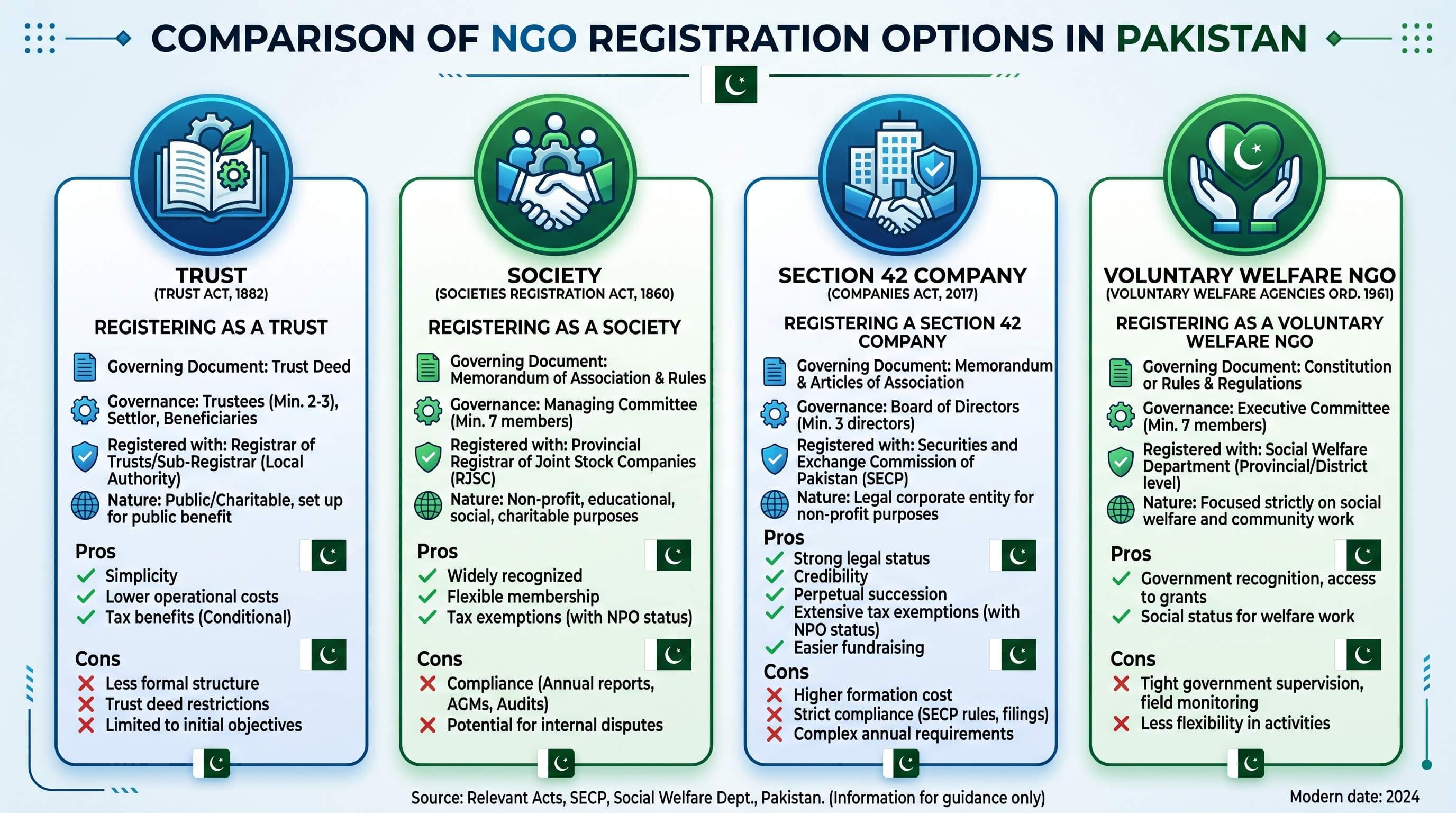
The NGO must be properly registered under one of the legal frameworks (Trust Act 2020, Section 42 Companies Act 2017, Societies Registration Act 1860, or Voluntary Social Welfare Agencies Ordinance 1961).
Valid NTN from FBR and preferably PCP (Pakistan Centre for Philanthropy) certification for added credibility.
Clear objectives aligned with public welfare (not prohibited activities).
No involvement with banned or blacklisted entities.
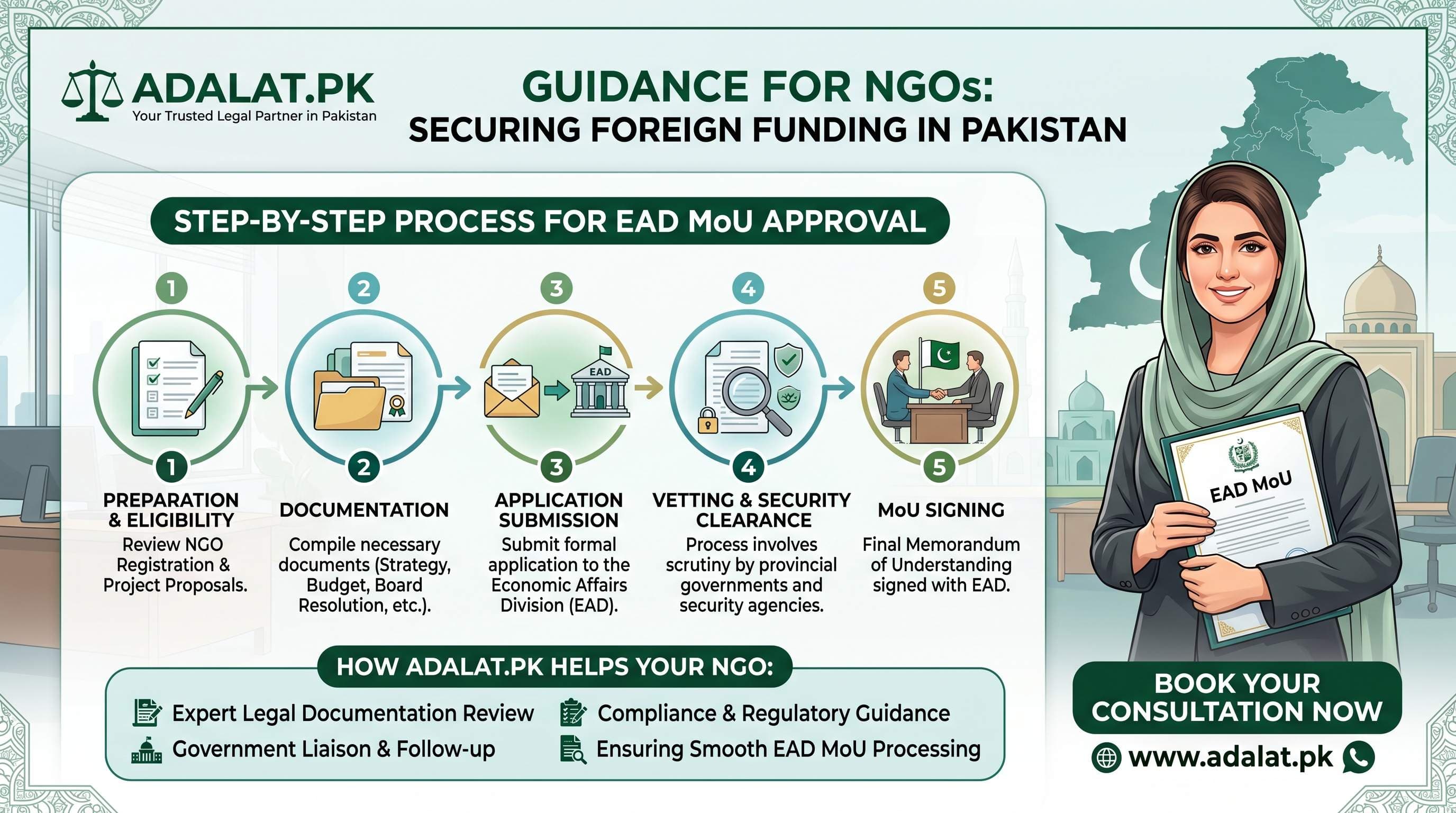
Step-by-Step Process for Foreign Funding Approval
Complete Basic NGO Registration — First register your organization under the appropriate law.
Create Account on EAD Portal — Register your NGO on the official EAD NGO e-Portal.
Submit Application — Provide:
Registration certificate and governing documents.
Details of proposed foreign donor(s) and commitment letter.
Project proposal, budget, and work plan.
Audited accounts (if existing).
CNIC/details of office bearers.
Undertakings regarding compliance with Pakistani laws
Security & Inter-Agency Clearance — Applications undergo screening by multiple agencies (including Interior Ministry, security agencies, and relevant line ministries).
MoU Signing — Upon approval, sign an MoU with EAD. This is usually project-specific or valid for a defined period.
Bank Account & Remittance — Open a dedicated Pakistani bank account. Inform the bank of EAD approval for smooth crediting of funds.
Ongoing Compliance:
Submit annual project reports and audited financial statements to EAD.
Quarterly or biannual fund utilization reports.
Maintain proper books and allow inspections.
Key Requirements under the 2022 Policy (Restored 2026)
Foreign contributions must be received only through formal banking channels.
Funds can only be used for approved purposes mentioned in the MoU.
NGOs must maintain separate accounts for foreign-funded projects.
Prohibition on funding to entities blacklisted by the Government of Pakistan.
Strict monitoring, with powers for suspension or termination of MoU in case of violations.
Annual reporting and audit by reputable firms.
Additional Compliances
FBR Tax Exemption — Apply for NPO status under Section 2(36) of the Income Tax Ordinance 2001 (PCP certification helps).
State Bank of Pakistan — Banks follow enhanced due diligence for NPO accounts.
Provincial Regulations — Some provinces (e.g., Punjab Charity Commission) may have additional oversight.
INGOs — International NGOs operating in Pakistan also require separate registration and agreements with EAD/Ministry of Interior.
Important Tips for Smooth Approval
Engage a lawyer or consultant experienced in EAD processes to prepare strong documentation.
Ensure strong internal governance, transparency, and audited records — this speeds up clearance.
Avoid sensitive activities without proper consultation (some sectors face higher scrutiny).
Start the EAD process well in advance — clearance can take several weeks to months.
Maintain regular communication via the EAD portal.
Note: The policy aims to facilitate legitimate development work while safeguarding national interests. Always refer to the official EAD website and latest notifications, as procedures may be updated.
Foreign funding, when managed compliantly, can significantly amplify your NGO’s impact in Pakistan. For professional assistance with EAD registration, MoU drafting, or full compliance packages, consult qualified legal experts.
Watch Video
Tags
Videos
Related videos
NGO Registration Under Societies Act, 1860 #NGO #Societies act#Charity#Commission
NGO Registration in Pakistan #NGO #NPO
Difference Between NGO & NPO #NGO #NPO
Need legal advice?
Speak to our legal experts for practical guidance on your case.
Get a Free Consultation